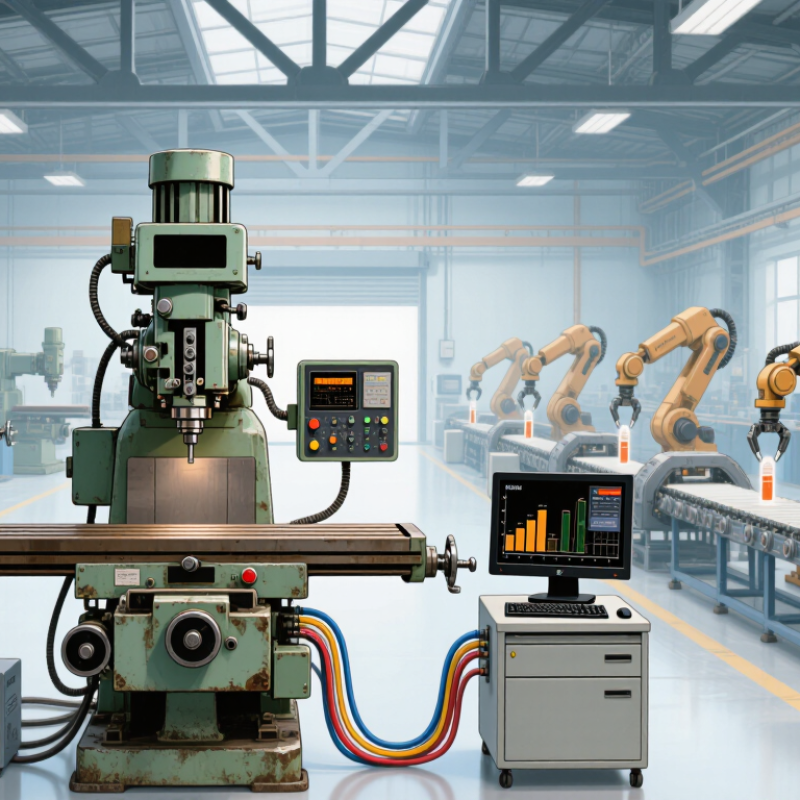
Factories rarely replace every machine at once. A decades-old CNC mill may still hold tolerances, while its controller cannot communicate with a modern manufacturing execution system. That tension explains why manufacturers are asking how to integrate legacy equipment with modern automation systems. The challenge is practical: connect valuable assets without disrupting production, safety, or product quality.
Deloitte’s 2023 Smart Manufacturing and Operations Survey found that 86% of manufacturing leaders expected smart manufacturing to become a primary competitiveness driver within three years. However, modernization does not always require a complete rebuild. A protocol gateway, industrial edge computer, or OPC UA adapter can translate signals from older PLCs into usable production data. Rockwell Automation’s 2024 State of Smart Manufacturing Report also highlights continuing investment in connected operations, artificial intelligence, and cybersecurity. These trends make integration urgent, but they do not make it simple.
The following seven tips focus on controlled, measurable progress. Start with an asset audit: record controller models, communication ports, sensor locations, cycle times, and failure history. Then define one visible use case, such as monitoring a press motor’s temperature before attempting full autonomy. Network segmentation, read-only data collection, and tested backups reduce operational risk. NIST guidance on industrial control systems reinforces the need to protect availability, reliability, and safety during technology changes. Still, a polished integration plan can fail when undocumented wiring or operator habits are ignored. That is a lesson worth admitting. Pilot carefully, involve technicians, and measure downtime, data accuracy, response time, and maintenance effort before scaling across the plant.
Audit Legacy Assets with ISA-95’s Five-Level Automation Hierarchy
Legacy integration becomes safer when the plant is audited before automation is purchased. ISA-95 provides a practical five-level map. It separates physical production from business planning. That separation exposes hidden gaps.
At Level 0, record machines, materials, temperatures, pressures, and operating limits. At Level 1, verify sensors and actuators against current drawings. Some signals may drift quietly. At Level 2, inspect controllers, alarms, sequences, and operator interfaces. Test failure responses, not only normal operation. These are three essential tips: map assets, verify signals, and test controls. Keep old equipment isolated from wider networks. Use approved gateways where direct connection creates risk.
At Level 3, examine production schedules, quality records, maintenance tasks, and operator instructions. Standardize names, units, timestamps, and batch identifiers before moving data upward. Do not automate every manual decision. Some workarounds exist because the original design was incomplete. At Level 4, compare production data with planning, inventory, purchasing, and reporting needs. Define who owns each data field. Pilot one process, document every change, and review results with operators. Those actions complete the seven tips: normalize data, limit scope, assign ownership, and improve through evidence. The audit may reveal that a modern interface cannot fix unreliable measurements. That is uncomfortable, but useful.
Rank Retrofit Targets Against OEE’s 85% World-Class Benchmark
7 Tips for Integrating Legacy Equipment with Automation
Rank retrofit targets against the 85% world-class OEE benchmark. Measure availability, performance, and quality for at least four weeks. A machine running at 62% OEE may deserve attention before a newer unit at 78%. Use actual stoppage records, not operator impressions alone. Data can be messy.
Map the largest losses. Verify whether downtime comes from changeovers, jams, slow cycles, or rejected parts. Check electrical drawings, safety circuits, communication ports, and available panel space. Add sensors where evidence is weak.
Start with one bottleneck, then run a controlled pilot. Keep the original controls available during testing. That safeguard reduces production risk. Train operators beside the equipment, using real alarms and recovery steps. Their practical knowledge often reveals problems dashboards miss.
Compare results with the 85% benchmark after stabilization, not during commissioning. A retrofit that lifts OEE from 55% to 70% may still be valuable, especially when it removes repeated manual checks. However, improvement should be measured in repeatable shifts, not one excellent afternoon.
Review the figures weekly and separate short-term gains from lasting performance. Some old machines need mechanical repair before automation can help. We once treated a sensor fault as a software issue and lost several shifts. That mistake changed our review process.
Automation is not a substitute for maintenance discipline. It makes weak processes more visible.
Bridge Protocols with OPC UA and IEC 62443 Zone-and-Conduit Controls
Integrating legacy equipment is rarely a plug-and-play task. Old controllers may speak serial protocols, use fixed addresses, and lack modern authentication. A practical bridge is OPC UA, placed at a controlled gateway. It can normalize tags without rewriting every machine program. Keep the gateway outside the most trusted control zone. That detail matters.
Map every asset, data flow, and required command before connecting cables.
Give each zone a clear purpose, such as production, supervisory control, or enterprise reporting. Define conduits between zones, allowing only approved protocols, ports, and directions. IEC 62443 zone-and-conduit thinking makes these boundaries visible and testable. Use certificate-based authentication, unique accounts, least-privilege permissions, and encrypted OPC UA sessions. Disable unused gateway services. Record failed connections and unusual write requests.
In field projects, I have seen teams trust a successful ping too quickly. Connectivity is not security. Test read-only operation first, then verify each permitted write under maintenance conditions. Keep a rollback plan and a safe manual mode. Review firewall rules with operations staff, not only network specialists. Firmware gaps and undocumented settings can still undermine a sound design. I would revisit the model after every production change; assumptions age faster than equipment. Small mistakes remain possible. Record them, correct them, and retest.
Pilot One Cell: Require ≥99% Tag Accuracy Before Scaling
7 Tips for Integrating Legacy Equipment with Automation
Pilot one cell before connecting an entire production line. Define every tag clearly, including its name, unit, state, timestamp, and source. The target is at least 99% tag accuracy before scaling. This means commands, alarms, counts, and status signals must match physical events. In one retrofit project, a duplicated sensor tag created false downtime reports. We corrected the mapping, but only after operators noticed the mismatch. Human review still matters.
Tip 1: Create a tag dictionary with engineering and maintenance staff. Test each signal during real machine cycles, not only during idle periods. Tip 2: Compare digital values with physical evidence, such as panel indicators, measured temperatures, and completed part counts. Record every exception. A clean spreadsheet is not proof.
Tip 3: Run the pilot through normal shifts, changeovers, and minor faults. Set acceptance checks for missing data, delayed updates, incorrect units, and unexpected states. Keep a versioned record of every mapping change. Our first pilot used an overly simple fault category, which hid useful details from technicians. That design needed revision. Scaling should wait until the cell performs reliably under pressure, and operators can explain what each critical tag means.
7 Tips for Integrating Legacy Equipment with Automation? - Pilot One Cell: Require ≥99% Tag Accuracy Before Scaling
| Tip |
Integration Focus |
Key Data Dimension |
Pilot Acceptance Threshold |
How to Measure |
Scaling Gate |
| 1 |
Inventory existing equipment and controls |
Asset coverage and interface availability |
100% of pilot-cell assets documented |
Record equipment ID, controller type, signal source, protocol, signal direction, and data owner for every asset. |
No unidentified critical asset before commissioning |
| 2 |
Standardize tag naming and metadata |
Tag accuracy and completeness |
≥99% tag accuracy; 100% of critical tags mapped |
Compare source tags with the approved tag dictionary and verify units, data types, scaling, descriptions, and alarm states. |
Maintain ≥99% accuracy for 10 consecutive production shifts |
| 3 |
Use a protocol gateway where direct connection is impractical |
Data delivery reliability |
≥99.5% successful message delivery |
Count valid messages received by the automation layer versus messages expected during operating periods. |
No unresolved communication loss lasting more than 5 minutes |
| 4 |
Preserve original control behavior |
Command safety and interlock integrity |
0 unauthorized control actions; 100% interlock tests passed |
Run supervised read-only tests first, then execute approved commands using documented permissives and rollback steps. |
Operations and maintenance sign-off required before write access |
| 5 |
Validate time synchronization and event order |
Timestamp quality |
≥99% of events within ±1 second of the reference clock |
Compare controller, gateway, historian, and supervisory-system timestamps during normal and fault conditions. |
No ambiguous event sequence during fault-recovery testing |
| 6 |
Design for failure and graceful degradation |
Recovery and data buffering |
Automatic recovery within 15 minutes; ≥99% buffered data retained |
Simulate network interruption, controller restart, gateway restart, and power restoration while checking data continuity. |
Manual operating procedure available for every single-point failure |
| 7 |
Measure business value before expanding |
Performance, downtime, and operator workload |
≥5% improvement in the selected pilot KPI without increasing safety risk |
Compare a defined pre-pilot baseline with at least 4 weeks of post-pilot results using the same calculation rules. |
Scale only after technical, safety, and financial reviews are approved |
| Recommended scale decision: proceed only when the pilot achieves ≥99% tag accuracy, passes all critical safety tests, sustains the communication target, and demonstrates measurable operational value. |
Prove Value with MTBF, MTTR, Downtime Cost, and a 12-Month ROI Gate
7 Tips for Integrating Legacy Equipment with Automation
Legacy equipment should earn its place before automation expands around it. Start with MTBF, MTTR, and downtime cost. MTBF shows how long assets operate between failures, while MTTR exposes recovery weakness. Track both by machine, shift, and failure mode. The U.S. Department of Energy reports that effective predictive maintenance can reduce maintenance costs by 8–12% and improve equipment availability. Numbers beat optimism.
Calculate downtime cost using lost output, labor, scrap, energy, and delayed deliveries. A 2024 industrial reliability report from Siemens Financial Services estimated that unplanned downtime can cost large industrial companies millions of dollars annually. Your plant may be different. That is the point. Use local evidence, not impressive averages. Photograph the control cabinet, record restart minutes, and validate production losses with finance.
Set a 12-month ROI gate before approving a full retrofit. Month one should establish baseline performance. Months two through four can test sensors, alarm rules, and manual workflows on one bottleneck. Compare new MTBF and MTTR against the baseline each month. Include training, integration, cybersecurity, and spare parts in the investment case. The International Society of Automation recommends lifecycle thinking for industrial control systems, yet many projects underfund maintenance after launch. That mistake is common. If payback remains unclear after twelve months, pause, investigate, and redesign the scope.
Conclusion
Integrating older machinery into a modern automation environment requires a structured, risk-based approach. Start by auditing every asset according to the five-level automation hierarchy, documenting its controls, data availability, condition, and communication limits. Then rank retrofit candidates using production impact, maintenance history, safety needs, and the 85% OEE world-class benchmark. A clear assessment helps determine which equipment should be upgraded, connected, replaced, or left unchanged.
The practical question is how to integrate legacy equipment with modern automation systems without disrupting operations. Use protocol bridges such as OPC UA and apply IEC 62443 zone-and-conduit principles to separate and protect industrial networks. Begin with one production cell, validate data mapping, and require at least 99% tag accuracy before expanding. Finally, measure success through MTBF, MTTR, downtime cost, and a defined 12-month ROI gate. This approach limits implementation risk while creating measurable improvements in visibility, reliability, productivity, and long-term maintenance planning.

 Eeptron PLC